7 views0 copies
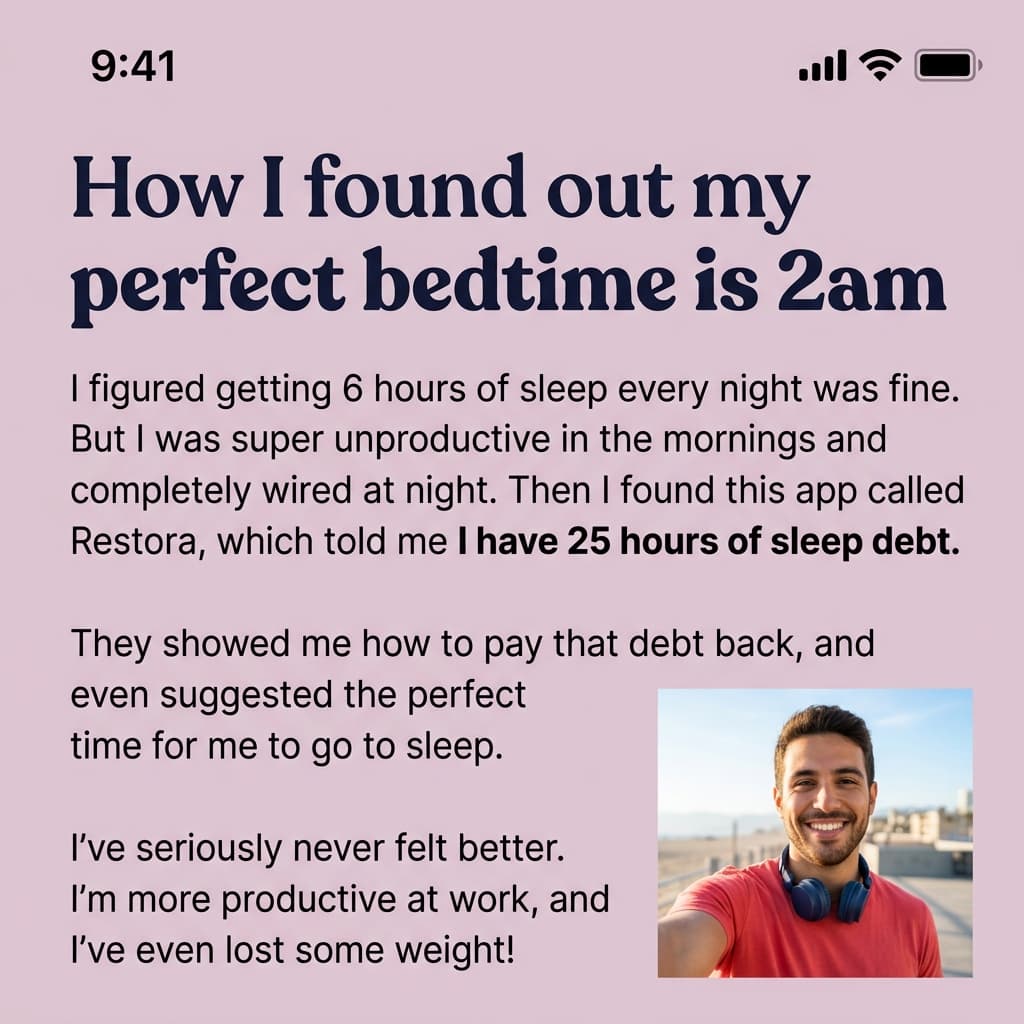
Restora — How I Found Out My Perfect Bedtime Is 2am
Prompt
A native, editorial, UGC-style native content advertisement designed to mimic a blog post or article being read on a smartphone, featuring a personal-story headline, multi-paragraph testimonial body text with bold emphasis, and a casual selfie photograph — all on a soft muted pink-lavender background with a phone status bar at the top. The overall aesthetic is content-native, article-like, and deliberately non-advertising. [Full Frame — Faux Smartphone Article View, Square Format] The entire 1:1 square composition replicates the experience of reading a blog post or article on a smartphone screen. The background is a flat, solid, soft muted pink-lavender (#E0D0E0) — a calming, slightly dusty pastel that reads as gentle and sleep-associated. The layout is a single-column text article with a headline at the top, body paragraphs below, and a small photo inset in the lower-right. The entire frame has the feel of a content page being scrolled through — not a designed ad but an article someone would encounter on a wellness blog or news app. [Top Edge — Phone Status Bar] Across the very top of the frame, a standard iOS phone status bar is displayed against the same pink-lavender background: the time "9:41" in bold, small sans-serif in dark charcoal (#2B2D42) on the left (Apple's default demo time). On the right, standard system icons: cellular signal bars, Wi-Fi signal icon, and a battery icon showing nearly full charge — all rendered in dark charcoal (#2B2D42). This status bar detail is essential for the illusion — it frames everything below as content being viewed on a real phone. [Upper Section — Article Headline] Below the status bar, with comfortable top padding, the article headline reads: "How I found out my perfect bedtime is 2am" The headline spans three lines, left-aligned, in a large, bold, heavy-weight, sentence-case serif typeface in deep dark navy (#2B2D42) — Restora's secondary brand color. The serif style is classical with moderate thick-thin stroke contrast — editorial, warm, and authoritative. The first line "How I found out my" is in regular-weight, while "perfect bedtime is 2am" on the second and third lines is in extra-bold weight — creating a deliberate emphasis shift that draws the eye to the surprising, curiosity-triggering claim. The "2am" bedtime is the hook — it's counterintuitive enough to make anyone stop scrolling and think "wait, that can't be right." [Center Section — Article Body Text, Three Paragraphs] Below the headline, the article body text is displayed in standard blog-post formatting — left-aligned, comfortable margins, readable line spacing. The text is in regular-weight, sentence-case, standard-size sans-serif in dark charcoal (#2B2D42 at approximately 80% opacity, reading as a softer dark). The body text reads across three informal, conversational paragraphs: Paragraph 1: "I figured getting 6 hours of sleep every night was fine. But I was super unproductive in the mornings and completely wired at night. Then I found this app called Restora, which told me I have 25 hours of sleep debt." The phrase "I have 25 hours of sleep debt." is in bold — heavier than the surrounding text — creating emphasis on the shocking metric that the app revealed. This is the key conversion moment: the concept of "sleep debt" is specific, quantified, and alarming enough to make the reader want to check their own. Paragraph 2: "They showed me how to pay that debt back, and even suggested the perfect time for me to go to sleep." Regular weight throughout — a transitional paragraph explaining the app's solution. Paragraph 3: "I've seriously never felt better. I'm more productive at work, and I've even lost some weight!" Regular weight — the payoff paragraph listing concrete benefits (productivity, weight loss) that extend beyond just "better sleep." The three paragraphs have natural spacing between them — approximately 1.5x line height gaps — matching standard blog post formatting. The writing style is conversational, first-person, and authentically informal — "super unproductive," "completely wired," "I've seriously never felt better" — exactly how a real person would write a personal blog post or Reddit testimonial. [Lower-Right — Selfie Photograph] In the lower-right corner of the frame, a small rectangular photograph (approximately 30% of frame width, 25% of frame height) shows a casual selfie of a young man, approximately late 20s to early 30s. He has warm medium skin tone (#C8A078), short dark brown hair, a neatly trimmed beard/stubble, and a broad, genuine smile showing teeth — radiating energy and well-being. He wears a bright coral-red (#E05040) t-shirt and dark blue (#2B3A5A) over-ear headphones hung around his neck. The background of the selfie shows a bright, slightly blurred outdoor scene — a clear blue sky (#A0C8E8) and what appears to be a beach boardwalk or urban rooftop. The lighting is bright, natural daylight — warm and vibrant. The photo is positioned with its right and bottom edges aligned near the corner of the frame, with the article body text wrapping around its left and top edges — exactly how an inline image would sit in a blog post with text wrap. The photo adds a human face to the testimonial, communicating health, vitality, and the "after" state of someone who fixed their sleep. The casual selfie quality (slightly angled, arm extended) reinforces the UGC authenticity — this is a real person sharing their story, not a model. [Color Specifications] Soft muted pink-lavender background (#E0D0E0), status bar elements dark charcoal (#2B2D42), headline dark navy (#2B2D42), body text dark charcoal (#2B2D42 at ~80%), bold emphasis text full dark (#2B2D42), selfie skin tone warm (#C8A078), selfie t-shirt coral-red (#E05040), selfie headphones dark blue (#2B3A5A), selfie sky blue (#A0C8E8), Restora brand purple (#7209B7), Restora brand lavender (#F0E6FF), Restora brand dark (#2B2D42). [Typography Specifications] Status bar time "9:41": bold, small, system sans-serif in dark charcoal (#2B2D42). Headline "How I found out my": regular-weight, sentence-case, large editorial serif in dark navy (#2B2D42). "perfect bedtime is 2am": extra-bold, sentence-case, same serif in dark navy — heavier weight for emphasis. Body paragraphs: regular-weight, sentence-case, standard-size clean sans-serif in dark charcoal (#2B2D42). Bold phrase "I have 25 hours of sleep debt.": bold weight within the body text. No brand logo, no CTA, no rating, no designed elements — the content IS the advertisement. The overall composition feels like a screenshot of someone's phone while reading a personal wellness blog post — the kind of content that gets shared in group chats and wellness communities because it reads as a genuine personal discovery story, not an ad. The "2am bedtime" headline is a masterful hook: it's surprising enough to stop any scroller (everyone has opinions about bedtime), and the article below explains the counterintuitive logic in a way that makes the reader curious about their own sleep debt. The concept of "25 hours of sleep debt" is the key conversion mechanism — it introduces a quantified problem the reader didn't know they had, and positions Restora as the app that both diagnoses and solves it. The three-paragraph structure mirrors the classic storytelling arc: problem (I was unproductive and wired), discovery (the app told me something shocking), and transformation (I've never felt better). The overall mood is personal, relatable, and quietly transformative — positioning Restora not as a sleep tracker but as the app that reveals a hidden truth about your body and then guides you to a better life. The soft pink-lavender (#E0D0E0) background is deeply sleep-coded — calming, gentle, and unconsciously associated with rest and nighttime — while the deep navy text (#2B2D42) and the vibrant selfie provide enough contrast and energy to keep the ad from feeling sleepy itself. High resolution, digitally composed faux-smartphone article/blog view with phone status bar, editorial headline, body text paragraphs, and inline selfie photograph on flat pastel background, social media native content ad format, 1:1 square aspect ratio.
AI Model
Nano Banana 2
Category
Health & FitnessSubmitted by
Martin
@martinvarto